

Paul McNamara

Organizations are being asked to produce faster, more reliable, more competitive outcomes with capabilities that were often built for an earlier set of conditions.
Technology is advancing. Customer expectations are rising. Complexity is increasing. New tools are creating new possibilities for how work can be organized and executed. Yet many companies are still operating with structures, habits, and practices that evolved around the limitations of an earlier industrial environment.
That creates a widening gap between what the organization must become capable of producing and what its current way of operating can reliably deliver.
And waiting does not preserve the current position. In a changing environment, waiting changes the position.
The Breakdowns Are Familiar
The symptoms often show up in familiar ways.
Schedules and information are fragmented across groups. Critical equipment is difficult to find or unavailable when needed. People hold onto resources because they are not confident they will be able to get them back later. Experienced employees rely on private spreadsheets, workarounds, and personal networks to keep work moving. Commitments and ownership are not always clear. Functions optimize locally while programs struggle globally.
These visible breakdowns often show up first as Control problems: poor schedule visibility, resource conflicts, incomplete information, unclear status, or difficulty knowing what is actually happening.
Those problems matter. But they may only be where the capability gap first becomes visible.
A scheduling tool may solve a scheduling problem. It does not necessarily create the broader capability to coordinate commitments, resources, changing situations, execution, and learning across the test process.
New technologies may be introduced, but old ways of working remain.
The problem is usually not that people are unwilling to work hard. Many organizations continue to produce acceptable outcomes only because capable people are working heroically around weaknesses in the system.
But heroic effort is not the same thing as mature capability.
From Process Maturity to Capability Maturity
Traditional maturity models provide real value. They help organizations establish common practices, reduce variation, create greater discipline, and move from reactive ways of operating toward more predictable and continuously improving processes.
Equipment-management maturity models such as ASTM E2452 are examples of this approach: they provide a structured way to assess the maturity of equipment-management practices and identify where greater discipline and improvement are required.
Our capability maturity models build on a related idea, but begin with a different question.
Not simply:
How mature is this process?
But:
What must the organization become capable of producing, and what must mature to produce that outcome reliably and competitively?
A capability is the ability to produce an outcome.
Capability maturity is the deliberate design and improvement of the capital structures required to produce that outcome.
Those structures include human capital—people, their skills, judgment, identities, roles, relationships, and organization; capital equipment—the physical and technical assets used to produce outcomes; capital inventory—the practices, workflows, governance methods, narratives, data, and accumulated knowledge that guide action; operating capital—the cash required to run the business; and financial capital—surplus capital available to fund new capabilities and opportunities.
A maturity model should therefore do more than establish good common practices or tell an organization where it stands.
It should help leaders understand what must improve next, why it matters, and what better outcomes should become possible as a result.
We do not always know all of the capabilities required at the outset. We discover some of them through action. We hold an intention, attempt to produce an outcome, and notice where the result falls short. Those gaps reveal practices, skills, structures, systems, narratives, or forms of coordination that may be missing, weak, incomplete, or flawed. As capability improves, new requirements often become visible that could not easily be seen before.
Maturity Has to Be Sequenced
Organizations do not become mature all at once.
You cannot meaningfully integrate what you cannot yet see and manage. It is difficult to make an organization Accountable when commitments, ownership, responsibilities, and current conditions remain unclear. And sustained optimization is impossible if the organization has not developed enough discipline and integration to learn systematically from what happens.
That is why we sequence capability maturity as:
Control → Accountable → Integrated → Optimizing
The purpose is not to force every organization through a rigid checklist. It is to start with the capability the organization actually has today and deliberately build what comes next.
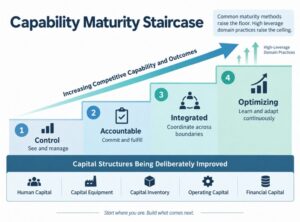
Control: See and Manage the Work
Control begins with visibility and basic operating discipline.
The organization develops reliable information about work, resources, schedules, commitments, status, and changing situations. Common practices begin to replace scattered local methods. Leaders and teams gain a factual view of what is happening and where breakdowns are emerging.
Control is often where organizations first recognize the need to improve because the breakdowns are visible: schedules conflict, resources are unavailable, information is scattered, and leaders cannot reliably see current conditions.
Solving those problems is valuable. But Control is the foundation, not the destination.
Once visibility improves, organizations often discover that the next constraints involve commitments, ownership, cross-functional coordination, and learning.
Accountable: Turn Visibility Into Commitments
Visibility alone does not produce better outcomes.
An Accountable organization turns that visibility into explicit commitments, ownership, responsibilities, and outcomes.
People understand what they owe one another. Commitments can be managed rather than assumed. Breakdowns surface earlier. Governance becomes more effective because leaders are working from shared facts and explicit promises rather than inference and ambiguity.
Being Accountable is not about blame. It is about organizing people around commitments and their fulfillment.
Integrated: Coordinate Around Shared Intentions
As capability grows, the limitations created by functional and system boundaries become more visible.
Integrated maturity connects people, workflows, equipment, information, and systems around shared intentions.
Functions coordinate across boundaries rather than optimizing independently. Systems are integrated where doing so reduces accidental complexity and improves execution. Information, commitments, resources, and changing situations become increasingly available to the people who need them.
The result is less fragmentation, fewer handoff failures, and faster cross-functional fulfillment.
Optimizing: Learn Faster Than Conditions Change
A mature capability cannot simply be installed and maintained.
Years ago, customers would sometimes tell us they wanted to implement software and then keep it essentially unchanged. The problem was simple: the marketplace was not going to remain unchanged with it.
Standing still operationally can mean moving backward competitively.
At the Optimizing level, organizations systematically learn from outcomes, breakdowns, reviews, changing situations, and emerging technologies. They improve not only individual practices, but their ability to Control, remain Accountable, Integrate, and learn.
A mature capability therefore does not merely perform well today.
It learns faster than conditions change.
Start With the Visible Problem—But Do Not Let It Define the Entire Capability
Many organizations begin their maturity journey because they need better visibility, scheduling, or resource coordination.
That is often the right place to start.
The value of the maturity model is that it helps leaders distinguish between solving the immediate Control problem and building the broader capability required to sustain better outcomes over time.
A useful progression is:
See the work → Coordinate the commitments → Connect the system → Learn and improve
That maps directly to:
Control → Accountable → Integrated → Optimizing
The visible problem gets attention. Attempts to fulfill the larger intention reveal where capability is still falling short, and the maturity model helps leaders understand what must develop next.
One Maturity Model. Two Reinforcing Capabilities.
At Sente, we apply the same maturity architecture to two complementary capabilities.
Test Resource Management (TRM) focuses primarily on improving the productivity, availability, utilization, and lifecycle management of capital equipment while reducing the burden that resource constraints place on engineers and other people.
CoordinateTRM (CTRM) focuses more directly on the human and knowledge side of test execution—coordinating people, commitments, schedules, changing situations, decisions, and learning around shared intentions.
The two reinforce one another.
Better resource availability makes coordinated execution easier. Better coordination makes more productive use of equipment and exposes new opportunities to improve the resource system.
As visibility improves, CTRM helps mature the commitments, coordination, situation awareness, and learning required to turn that visibility into faster and more reliable fulfillment.
Both capabilities mature through the same progression—Control → Accountable → Integrated → Optimizing—but the high-leverage practices used to improve them are different.
Common Maturity Methods Raise the Floor. High-Leverage Domain Practices Raise the Ceiling.
Common maturity methods are important because they create a stable foundation. They reduce chaos, improve consistency, and make performance more predictable.
But competitive advantage often comes from going further.
Within a specific domain, some practices, mechanisms, technologies, and ways of coordinating can create disproportionately large improvements in outcomes. We think of these as domain-specific marginal utilities—high-leverage ways of operating that produce outsized improvement in a particular capability.
In Test Resource Management, for example, simply tracking equipment more accurately is useful. But the larger opportunity may come from improving availability, sharing, readiness, utilization, cost allocation, technology alignment, and the speed of engineering work.
In CoordinateTRM, the high-leverage practices may involve better situation awareness, clearer commitments, cross-functional coordination, post-test learning, and stronger use of shared knowledge.
The practice matters because of the outcome it enables.
This is where maturity can move beyond operational discipline and begin creating asymmetrical advantage.
Two organizations may both have sound foundational practices. The one that learns how to use its people, equipment, knowledge, systems, and capital in more powerful ways can produce very different outcomes.
The Outcomes Can Be Significant
When the underlying capability matures, the effects show up in operational and economic performance.
In our work with Test Resource Management and Lab Management environments, we have seen process speed improve by roughly 25–35% for TRM and 50–75% when TRM and Lab Management are combined. Equipment utilization has increased by as much as four times in some environments. Calibration and maintenance costs can decline materially, while engineers spend less time working around the system and more time producing valuable outcomes.
The point is not that every organization will produce the same numbers.
The point is that capability maturity is not an abstract exercise.
When people, practices, technology, equipment, governance, and knowledge become more coherent—and when high-leverage domain practices are added to that foundation—performance can change materially.
Capability Maturity Is Also About People
There is a human side to maturity that is easy to miss.
Organizations have obligations to create the conditions in which people can succeed—to provide useful tools, training, clear roles, effective governance, good information, and opportunities to learn.
Employees also have obligations to learn, adapt, cooperate, and improve their ability to contribute.
Champions create the governance and organizational space required for change.
Early in the maturity journey, change agents inside the culture—often innovators and early adopters—are especially important. They translate new practices into local language, help integrate them with existing work, coach people through unfamiliar situations, and demonstrate that the new approach produces better outcomes.
As those outcomes become visible and the practices become embedded in roles, systems, governance, and everyday work, the organization becomes less dependent on the change agents.
The broader organization makes the capability real at scale.
As that happens, teams become more Relevantly Connected and more Committedly Engaged, enabling increasingly Competitive Outcomes.
For the company, those outcomes create opportunities for stronger growth, margins, resilience, and competitiveness.
For employees, they create opportunities to contribute, learn, advance, and build successful careers.
What Should Mature Next?
The most useful question is not simply:
How mature is our process?
A better set of questions is:
What capability are we responsible for producing?
What threats are emerging if we do not improve?
What obligations are we struggling to fulfill?
What new opportunities could stronger capability make possible?
Do we need greater Control?
Do we need to become more Accountable?
Do we need to become more Integrated?
Or do we need to become better at Optimizing—learning and adapting faster than conditions change?
And what would the next level allow us to produce that we cannot reliably produce today?
The purpose of a capability maturity model is not to reach a level on a chart.
It is to help an organization keep fulfilling competitively as technologies, expectations, and marketplace conditions change—while creating greater opportunities for people to contribute, learn, and succeed.
Start where you are. Build what comes next.
Request a Demo
See how Scireo TRM Software drops asset and support costs by 50% while accelerating time-to-market 2X.
Relevant Content
Case Study: Turning Test Experience Into Faster Execution
How CoordinateTRM helped an aerospace test organization improve coordination, reuse operational knowledge, and increase test speed by 50 to 75 percent The Challenge The customer’s test organization supports multiple programs competing for specialized facilities, equipment, engineering support, and other constrained resources. Success requires close coordination among the lab, its program customers, project engineering, managers, and…
Case Study, Utilization, Cost, and Speed: Space Company Leverages Assets
The hoarding culture was slowing this company down while impacting cost and quality. See how a journey to common processes and collaboration lead to a 50% reduction in assets as their business doubled.
Notable Quotes
Sente’s TRM practices have made a significant, measurable impact on our bottom line. Equally valuable to me is how they’ve contributed to my efforts to create a more collaborative environment in my engineering groups. Director of Engineering