

Paul McNamara

For years, many large companies pursued the idea of “one system” to manage everything.
The intention was understandable. A single system promised consistency, visibility, control, and a trusted source of truth. Large enterprise systems such as SAP, Maximo, IFS, PLM platforms, and other enterprise applications have delivered real value toward those intentions. They manage financial records, asset masters, procurement, compliance, inventory, maintenance, and standardized workflows across large organizations.
They create robustness.
But many companies have also learned a hard lesson: the system that governs the enterprise is not always the best system to execute the work.
This is especially true in operating environments where speed, uncertainty, technical complexity, and coordination matter. Testing labs, engineering operations, production support functions, and field service organizations often need more than enterprise control. They need execution-level resilience.
They need to see what is happening now. They need to know what is blocking progress. They need to understand which resources are truly available. They need to capture delays and risks while they are still actionable. They need to learn quickly enough to improve the next event, not merely document the last one.
That is the role of an execution-level system.
One Source of Truth Is Not One Point of Execution
One common architectural mistake is assuming that a single source of truth must also become the single point of execution.
Enterprise systems are designed for stability, standardization, and control. Changes to them often require governance reviews, IT prioritization, security approval, reporting analysis, and cross-functional alignment. That discipline is valuable.
But operating environments move differently. Equipment fails. Priorities change. People discover constraints. Resources are shared informally. Delays occur for reasons the enterprise system was never designed to capture.
When every operating change must be forced through the enterprise backbone, execution slows, adoption suffers, and hidden workarounds emerge.
The better architecture is not one system for everything. It is a governed blend of systems, each designed for the level at which it creates the most value.
Enterprise systems manage the state of the company.
Execution-level systems improve the flow of the work.
Why Execution-Level Systems Matter
The execution level is where intentions become outcomes.
It is where people coordinate, resources are used or wasted, risks become visible, and learning is either captured or lost. A company may own expensive equipment and still underutilize it. It may have asset records and still lack practical visibility into true availability. It may have maintenance schedules and still lose time to readiness failures.
The problem is not that the enterprise system is bad. The problem is that it was designed for a different job.
Asset visibility is not the same as utilization improvement.
An enterprise system can usually tell a company what it owns: the asset number, location, purchase date, depreciation schedule, maintenance status, and responsible department. That is valuable. But it does not necessarily tell leaders whether that asset is being used well.
Execution-level systems help answer harder questions:
Is the asset scheduled but sitting idle?
Is it reserved by one program while another has urgent demand?
Is a new capital request justified, or could existing resources be shared more effectively?
Are recurring delays revealing a practice problem that should be fixed?
This is where execution-level systems create economic value. They do not merely record assets. They help companies produce more value from the assets, people, and facilities they already have.
Integration Beats Replacement
The goal is not to replace enterprise systems.
Enterprise systems should remain the systems of record for finance, compliance, procurement, asset master data, and corporate reporting. They are essential to the governance of the company.
The better goal is integration.
Execution-level systems should connect to enterprise systems through clear APIs and governed data flows. The enterprise system receives the data it needs without forcing the operating team to do all of its work inside a tool that was not designed for its reality.
This allows each layer to do what it does best.
The enterprise system provides control, consistency, financial integrity, and auditability.
The execution-level system provides speed, context, learning, utilization improvement, and real-time coordination.
The integration between them creates translation. The operating level speaks the language of constraints, readiness, delays, utilization, and throughput. The enterprise level speaks the language of financials, compliance, procurement, asset lifecycle, and reporting.
A good architecture connects those languages without forcing one to become the other.
Governance Makes the Blend Work
Adding execution-level systems without governance can create confusion. Companies are right to worry about fragmented data, inconsistent practices, and local optimization that undermines enterprise coherence.
The answer is not to eliminate execution-level systems. The answer is to govern them well.
A useful governance model clarifies three things:
What is required: the data, controls, standards, and practices that must be followed.
What is forbidden: the actions that create unacceptable risk or undermine enterprise commitments.
What is allowed: the space where local teams can adapt, improve, and innovate.
This distinction matters. Large organizations often struggle because they treat too much as either required or forbidden. When that happens, teams lose room to improve. They work around the system, wait for permission, or stop trying to innovate.
A good execution-level system creates a safer space for improvement. It enables local adaptation while preserving enterprise trust.
What We Have Learned in Practice
Our work in Test Resource Management has taught us these lessons over many years.
We did not originally set out to build another large enterprise system. Our intention was more specific: help companies get products to market faster, use expensive test resources more effectively, reduce cost, and improve the operating practices that determine whether test organizations succeed.
Over time, our system, Scireo, has been used in enterprise-scale environments because the problem itself is enterprise-significant. Test resources are expensive. Test delays affect product schedules. Poor utilization creates unnecessary capital demand. Recurring breakdowns waste time and knowledge. Here’s more information about Scireo as an execution system (link this)..
But the lesson is broader than any one system.
Companies need execution-level capability in the areas where outcomes are produced. For test organizations, that means improving utilization, scheduling, readiness, delay capture, risk management, asset sharing, and continuous learning.
When those capabilities are integrated with enterprise systems, the organization does not have to choose between control and speed.
It can have both.
The Right System at the Right Level
The future is not one system.
The future is a more intelligent architecture: enterprise systems for governance and execution-level systems for operational performance, integrated through clear APIs, disciplined governance, and shared intentions.
This is how companies preserve the robustness they need while developing the resilience they increasingly require.
Enterprise systems manage the state of the company.
Execution-level systems improve the flow of the work.
Companies that understand the difference — and govern the blend well — will be better positioned to move faster, use capital more effectively, learn from execution, and produce uncommon results.
Request a Demo
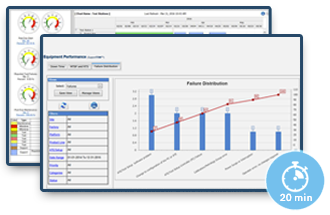
See how Scireo TRM Software drops asset and support costs by 50% while accelerating time-to-market 2X.
Relevant Content
“One Company” Is a Capability, Not a Slogan
Many organizations aspire to operate as “One Company.” The phrase appears in values statements, leadership messages, and strategic plans because it points to something real and important: the belief that an unselfish, cohesive, and inclusive organization is more powerful than a collection of well-intentioned but disconnected teams. And yet, despite sincere commitment, many companies struggle…
Software Accelerates Transformation When Designed With That Intent
Why Trust What we Say? The results we help our customers produce with our software and practices are unmatched. You can hear one of our customers talk about it in a video linked to this blog post. In a marketplace understandably cynical about the claims of software vendors, the truth is in outcomes, and we’ve…
Notable Quotes
You guys aren’t a normal software vendor. When you promise results, you really mean it. — Director Asset Mgt.