
Paul McNamara

Industrial revolutions are triggered by the introduction of new tools. Companies that learn how to exploit these tools with a comprehensive capital structure strategy win. Those who do it first dominate. New tools create possibilities. Competitive advantage comes from developing the capital structures and capabilities required to exploit them. Companies that are engaged in “transformation” efforts must be focused on transforming the totality of their capital structures – not just their capital equipment – and have their complete set of capital structures aimed at enterprise goals and supporting enterprise strategies.
Traditional Thinking About Capital is Flawed and Incomplete
When most people think about capital, they think of capital equipment and the processes associated with it, all typically the purview of finance or capital managers. While these managers can plan for, acquire, and then measure and report metrics like return-on-assets, they cannot produce those returns without an intention to do so and a lot of directed help. Why? Because tools do nothing. They cannot produce returns by themselves.
We Need to Think about Capital Like an Economist
Economists define capital as anything businesses or individuals use to make money. ANYTHING. Not just capital equipment. To compete in today’s ultra-competitive marketplace, we all need to start thinking like economists. The first step is to distinguish categories of capital structures.
Categories of Capital Structures
When we distinguish categories of capital structures, we can begin thinking more strategically about how to produce the transformation of capital required to compete in today’s complex and ultra-competitive marketplace.
Human Capital is the value of the commitments people can make and fulfill. It is a result of their accumulated knowledge. It is this knowledge that produces returns on capital equipment. Human Capital is the first and most important category of capital.
Capital Equipment is any tool or artifact used to make money. Tools and artifacts amplify human capital.
Capital Inventory is the array of practices, narratives, and strategies companies use to make money. This also includes inventories of products or services ready to be sold.
Operating Capital is the cash required to operate the enterprise. When capital structures are coherently organized, they amplify each other, producing surpluses in cash.
Financial Capital is cash used to invest in a new enterprise or endeavor, often from surpluses.
These capital structures do not operate independently. They form a system. Human capital uses capital equipment and capital inventory to produce outcomes, while operating and financial capital enable continued operation, investment, and renewal.

Capital structures produce capabilities
A capability is the ability to reliably produce an intended outcome. Maturing a capability means intentionally designing and improving the capital structures required to produce that outcome.
That matters because transformation is not simply the acquisition of better technology. New equipment may be required, but so may new knowledge and skills, new practices and strategies, different operating structures, and new ways of learning. The capital structures have to develop together around the outcomes the enterprise intends to produce.
Transformation occurs when the capital structures underlying an important capability are redesigned enough that the enterprise can produce outcomes it previously could not reliably produce.
The High Cost of An Incoherent Capital Structures Strategy
I first came to understand the practical consequences of this incoherence while working in GE’s test equipment business.
I was an executive in one of GE’s Technology Management Services businesses in the late 90s. Our business rented, remarketed, repaired, and calibrated test equipment. Their fundamental offer was a “capital structures” offer helping companies with their test equipment capital equipment concerns and capabilities.
The first set of conversations I had with customers was focused on cost. According to them, ours were “too high.” Their returns were too low.
I could not help but think the vast majority of the “asset” challenges they described to me, and the costs driving them had human capital gaps at their root. Their capital strategy, if they had one, had to be incoherent. Once we started filling the human capital gaps, we produced and used our capital equipment (computers) and capital inventory (software & practices) to help our customers produce amazing results.
- 50% reduction in asset acquisition and support costs
- 35% improvement in time to market
- Higher levels of employee accomplishment and job satisfaction
No amount of focus on capital equipment alone – how to maintain it, how to control it, or whether to rent, lease or own it would have produced anything close to these results.
Directing Capital Structure Transformation with Mission and Strategy
My intention when I founded Sente was to create a company that helped its customers leverage their driving capital scarcities, all of them, to succeed in their mission. This required we understand our customers’ mission, strategy, and capital structures and align ours to augment and enable theirs. Over time, we have come to describe this development through four stages of capability maturity: Control, Accountable, Integrated, and Optimizing. These are not simply stages of software adoption. They describe increasingly capable capital structures: first making important work visible and controllable; then making commitments, ownership, and outcomes explicit; then integrating people, practices, information, and systems around shared intentions; and ultimately creating the ability to learn and continually improve the structures themselves. Our help would need to be better than the incremental improvements to costs offered by common asset management solutions. We were also committed to developing ways to help them with time-to-market, something no other asset management solution provider could fathom.
This was made possible by an important insight: many of the most significant asset management challenges were rooted less in the equipment itself than in the human skills, practices, commitments, and organizational structures required to use it effectively. To begin the process of capital structure transformation, we first needed to understand those relationships.
The Key Insight: Human and Organizational Capability Gaps Produce Cost and Speed Gaps
We’ve written about these gaps extensively in other blog posts, like Asset Management Success Factors: It’s the Humans, Stupid! There is no need to go into much detail here other than to explain why human capital has been such a gap in the asset management space.
The first reason is that people don’t understand the relationships between categories of individual capital structures and the performance of the whole. There is more written on this below.
In addition, companies invest in capabilities that are core to their business. I’ve learned over the years that regardless of whether executives talk this way publicly, they act this way when making decisions. Whenever there was a trade-off between investing capital in a non-core function or on core capabilities it was the core that always won. Over time these non-core functions starved of investment lost their competitiveness and many were outsourced to companies for whom the investment in capital structures was core. Companies are always going to invest their scarce capital in what matters most to them…their products and services.
For most of our customers, managing test resources will never be a core business capability in the same sense as designing, developing, and producing their products. That creates a persistent investment challenge. Scarce capital naturally flows toward the capabilities most directly connected to the company’s products, technologies, and customers. Over time, supporting capabilities can fall behind unless someone deliberately develops the specialized human capital, technology, practices, and knowledge required to keep them competitive.
This is one reason specialized partners can create substantial value. Their core business is developing and continually improving capital structures that customers would find difficult to justify building independently.
The Transformation of Capital Structures for Asset Management that Supports Today’s Missions and Strategies.
We could not help customers transform their capital structures unless we first built the capital structures required to do so. Our capital structures would need to be aligned in support of our mission and consistent with our insights. As strategic partners, our capital structures need to fill our customer’s capital structure gaps.
Human Capital: We required people with skills that went beyond the technical knowledge needed to understand capital equipment. Our people needed to understand economic principles, incentives, culture, communications, and business concerns to design and execute solutions (capital inventory) that enabled our mission.
Capital Equipment: We required the latest tools and technology that our people exploit with their knowledge to develop and execute practices supporting our mission. Our tools need to amplify our human capital. This means investing in and exploiting the latest scanning technology, software development, knowledge management tools, infrastructure, and security.
Capital Inventory: Building capital inventory with marginal utilities that are highly valuable to our customers is the responsibility of every employee at Sente. Capital inventory is not merely documentation. It includes the reusable practices, models, algorithms, narratives, strategies, and knowledge that allow people to repeatedly produce valuable outcomes. We require employees who can contribute in this way, designing offers and practices that accomplished our mission of reducing our customers’ asset costs by over 50% while accelerating development schedules by 50%. Our teams developed utilization algorithms, total-cost-of-ownership models, governance practices, culture-change, capacity, and risk algorithms, and many more capabilities along with the strategies and explanatory narratives required to execute and produce the results we promise.
When we put our capital structures to work for our customers, we helped them significantly cut operating capital requirements and time-to-market. We’ve won many customer-best-practice awards and have been recognized by industry analysts for the significant help our software and services provided.
Financial Capital: Operating capital improvements for our customer (through reduced costs and improved margins) and us (margins from highly-valued services) have allowed both of us to continue to increase investment in our capital structures. In the case of one customer below, we helped them double their revenues.
Video Case Study
I was asked to present on Digital Transformation at the 38th Symposium of the International Test and Evaluation Association in the fall of 2021. In the video, Digital Transformation: Asset Management 5.0, I provide background to our solution, interviewed a customer about their challenges prior to working with us, discuss our approach to their challenges, and wrap up with an interview with the customer on the results we produced together. Highlights of that interview are below:
Our customer also mentioned that his company chose to work with us because his team “felt Sente was going to do something with us, not to us.” An indication of the kind of helpful human capital we are committed to building.
Helping our Customers Transform Their Core Capital Structures and Further Accelerating Products to Market
Today our unique approach to managing capital equipment enables us to help our customers transform all of their capital structures, not just capital equipment. For instance, we help them improve their human capital by establishing practical learning practices and action structures. Teams use our software to instrument and measure the performance of their various processes, establish cause-and-effect explanations for the outcomes produced, then plan, execute, and measure improvements. In addition to the “embodied” knowledge (human capital) the teams build through their engagement and analysis, they establish a knowledge base (capital inventory) designed to be practically useful and easily searchable for future teams to use. This is what increasing capability maturity looks like in practice. Visibility and measurement establish greater Control. Clear commitments and ownership create greater Accountability. Connecting people, knowledge, processes, and technology creates an Integrated capability. And systematic learning enables teams to become increasingly Optimizing—improving not merely the work, but the capital structures that produce the work.
Learning is how capital structures become more mature: teams identify what was missing, flawed, incomplete, or weak in the structures that produced the prior outcome and then improve them. Practical Learning Practices applied to the test process, for instance, have improved cycle times by at least 50%.
Test Resource Management as Foundation for Broader Capability Transformation
Test equipment touches many of the enterprise processes required to develop, verify, produce, and support complex products. That makes Test Resource Management a particularly useful place to begin developing the human capital, capital equipment, capital inventory, and learning practices required for broader capability transformation.
Read more about this on Accelerate Transformation with Scireo TRM: Asset Management 5.0 and enjoy the free ebook, Enterprise Transformed.
Request a Demo
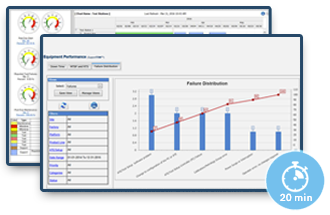
See how Scireo TRM Software drops asset and support costs by 50% while accelerating time-to-market 2X.
Relevant Content
Capability Maturity: Building the Ability to Produce Competitive Outcomes
Organizations are being asked to produce faster, more reliable, more competitive outcomes with capabilities that were often built for an earlier set of conditions. Technology is advancing. Customer expectations are rising. Complexity is increasing. New tools are creating new possibilities for how work can be organized and executed. Yet many companies are still operating with…
“One Company” Is a Capability, Not a Slogan
Many organizations aspire to operate as “One Company.” The phrase appears in values statements, leadership messages, and strategic plans because it points to something real and important: the belief that an unselfish, cohesive, and inclusive organization is more powerful than a collection of well-intentioned but disconnected teams. And yet, despite sincere commitment, many companies struggle…
Case Study, Utilization, Cost, and Speed: Space Company Leverages Assets
The hoarding culture was slowing this company down while impacting cost and quality. See how a journey to common processes and collaboration lead to a 50% reduction in assets as their business doubled.
Case Study: Aerospace Company Drives One Company Synergies
Like many aerospace companies, this one had many sites and different legacy cultures on each. See how they installed common resource management tools, increased utilization 3X and funded new programs.
Notable Quotes
What I loved about Sente’s approach is it felt as if they were going to do something with us, not to us. Test Engineer